Follow Greenville Nursing and Rehabilitation on Facebook! Click Here

To see a list of frequently asked questions please Click Here

Greenville | Nursing & Rehabilitation

Latest News

Latest News

Success Story: Beatrice Shultz

August 18, 2023

Greenville Nursing and Rehabilitation is excited to share resident Beatrice Shultz’s Success Story!

Ms. Beatrice Shultz, a long-term Greenville Nursing and Rehabilitation resident, was referred to therapy to address UE weakness and improve functional mobility to improve independence with self-care tasks.
Beatrice demonstrated great participation and progress and is at her prior level of function, requiring decreased assistance with her self-care task and functional mobility! Beatrice enjoys her morning coffee group, playing bingo, and talking to her fellow residents. She always has a smile on her face and enjoys participating in therapy and joking around with the therapists. Greenville Nursing and Rehabilitation is proud to have Beatrice with us and looks forward to the smile she gives to everyone! Congratulations to Beatrice and her Care Team on their success!

Healthy People 2030, Dementias Including Alzheimer’s

August 15, 2023

By 2060, almost a quarter of the U.S. population will be age 65 or older. Healthy People 2030 focuses on reducing health problems and improving quality of life for older adults.

Older adults are at higher risk for chronic health problems like diabetes, osteoporosis, and Alzheimer’s disease.

Core Objectives: Dementias Including Alzheimer’s Disease (DIA)

The Healthy People 2030 Core Objectives relate to improving the health and quality of life for people with Alzheimer’s Disease and related dementias. Measuring these objectives will provide valuable data to track progress throughout the decade.

  • Increase the proportion of older adults with dementia, or their caregivers, who know they have it. Learn more
  • Reduce the proportion of preventable hospitalizations in older adults with dementia.  Learn more
  • Increase the proportion of adults with subjective cognitive decline (SCD) who have discussed their confusion or memory loss with a health care professional. Learn more

All Healthy People 2030 core objectives meet several criteria, including having baseline data, a direct impact on health, and an evidence base, and they address the goals related to health, function, and quality of life. The Healthy People 2030 framework sets important health priorities for the nation over the next decade and will measure progress towards meeting those objectives.

For more information and an overview of all older adult objectives, please visit https://health.gov/healthypeople/objectives-and-data/browse-objectives/older-adults.

Dance Your Way to Better Brain Health!

August 7, 2023

JOIN A DANCE CLASS TO EXERCISE YOUR BRAIN AND BODY.

Exercise is not only good for your body, it’s good for your brain! Sticking to a regular workout plan can be tough, but including activity in your routine doesn’t need to be boring. Scientists have found that the areas of the brain that control memory and skills such as planning and organizing improve with exercise.1,2 Dance has the added dimensions of rhythm, balance, music, and a social setting that enhances the benefits of simple movement – and can be fun!

THE SCIENCE OF DANCE

At the University of Illinois at Chicago, through the CDC-funded Prevention Research Centers’ Healthy Brain Research Network, researchers designed a Latin ballroom dance program for older sedentary adults. Participants in the program, BAILAMOS©, reported improvements in memory, attention, and focus.3 In a separate ballroom dance program, older people experiencing mild cognitive impairment improved their thinking and memory after a 10-month-long ballroom dancing class.4

SO, HOW CAN YOU GET MOVING?

  • Sign up for a dance class and invite your friends to join. Find classes at your local community college, YMCA, dance studio, or community center.
  • Try dancing at home by following along with a DVD or videos on YouTube. Easy-to-follow, free exercise videos are available at the National Institute on Aging’s YouTube channel.
  • For an extra challenge, try using small weights to build strength. Keep a 2-pound or 5-pound weight in each hand while doing your dance routine. For more ideas on strength exercises, visit the Exercise and Physical Activity page on the NIH website.

Help for Caregivers of People with Alzheimer’s – Are you a caregiver for someone with Alzheimer’s disease or a related dementia? You can help the person you care for get moving, too.5

  • Split dance moves and exercises into small, easy-to-follow steps. Use exercise videos and follow along with the person you’re caring for.
  • At first, try shorter 5- or 10-minute mini dancing sessions to slowly build endurance.
  • Take breaks when needed and make sure you are both drinking plenty of water.

To learn more, please visit https://www.cdc.gov/aging/publications/features/alzheimers-and-exercise.html.

National Healthy Brain Initiative

July 31, 2023

The Healthy Brain Initiative improves understanding of brain health as a central part of public health practice. The initiative creates and supports partnerships, collects and reports data, increases awareness of brain health, supports populations with a high burden of Alzheimer’s disease and related dementias, and promotes the use of its Road Map series: State and Local Public Health Partnerships to Address Dementia: The 2018–2023 Road Map, and the Healthy Brain Initiative Road Map for Indian Country. The Road Map series provides actionable steps to promote brain health, address cognitive impairment, and address the needs of caregivers. In addition, the Healthy Brain Initiative supports the development of future Road Maps.

CDC is working with funded partners to accomplish the Road Map’s recommended actions. For example, the Alzheimer’s Association helps develop and track Road Map action items, and helps state public health agencies use them. Given that one out of every three American Indian and Alaskan Native elders develops dementia, the Association for State Territorial Health Officials (ASTHO) developed a series of health communication materials to improve quality, availability, and accessibility of public health resources to address the connection between brain health and heart health, Healthy Heart, Healthy Brain.

To learn more, please visit https://www.cdc.gov/aging/nationalinitiatives/national-healthy-nhbi.html.

Success Story: Phyllis Allen

July 31, 2023

Greenville Nursing and Rehabilitation is excited to shine the spotlight on resident Phyllis Allen’s Success Story!

Ms. Phyllis Allen was admitted to Greenville Nursing and Rehabilitation on May 31st of this year after a recent stay in the hospital with encephalopathy. Upon admission, Ms. Allen required extensive assistance with her transferring and walking, decreased endurance and muscle strength, required assistance with self-care tasks, and a severe decline in cognition.

Ms. Allen was very motivated to return home, where she lived independently on one level of her son’s home. Ms. Allen received skilled physical, occupational, and speech therapy during her short stay with us at Greenville Nursing and Rehabilitation. Ms. Allen also enjoyed socializing with fellow residents and enjoyed attending therapy sessions. Ms. Allen received skilled therapy for only 20 days, and she demonstrated great progress because of her hard work, determination, and motivation to return home. Ms. Allen was discharged to home on June 20th, where she was at the prior level of function she needed to live independently. Congratulations to Ms. Allen and her Care Team on their success!

Success Story: Bobby Gregory

July 21, 2023

Greenville Nursing and Rehabilitation is excited to share resident Bobby Gregory’s Success Story!

Mr. Bobby Gregory was admitted to Greenville Nursing and Rehabilitation on July 1st, 2022, due to his decline in functional endurance, decreased muscle strength, functional mobility, and poor carryover with energy conservation techniques and transfer, which led to his decreased ability to live at home.

Mr. Gregory received skilled Occupational Therapy and Physical therapies during his stay here. Because of his motivation and participation, he can perform his functional mobility, transfers, and self-care task with modified independence. Besides Mr. Gregory being a fun and sociable resident, he is also the community’s residential artist with several paintings he has drawn displayed throughout. He enjoys painting and giving his artwork to Care Team members and fellow residents. Various artwork by Mr. Gregory was displayed at a local art show. Mr. Gregory has even donated many of his beautiful paintings to be auctioned off here at Greenville Nursing and Rehabilitation Center, where he requested the proceeds go to the Activities department to benefit his fellow residents! Congratulations to Mr. Gregory and his Care Team on their success!

Mental Health and Aging

July 17, 2023

Mental health is important at every stage of life and it includes emotional, psychological, and social well-being.  As people age, they may experience certain life changes that impact their mental health, such as coping with a serious illness or losing a loved one. Although many people will adjust to these life changes, some may experience feelings of grief, social isolation, or loneliness. When these feelings persist, they can lead to mental illnesses, such as depression and anxiety.  Effective treatment options are available to help older adults and people at every stage of life to manage their mental health and improve their quality of life. Recognizing the signs and seeing a health care provider are the first steps to getting treatment.

Depression and Aging

Depression is not a normal part of growing older

Depression is a true and treatable medical condition, not a normal part of aging. However older adults are at an increased risk for experiencing depression. If you are concerned about a loved one, offer to go with him or her to see a health care provider to be diagnosed and treated.

Depression is not just having “the blues” or the emotions we feel when grieving the loss of a loved one. It is a true medical condition that is treatable, like diabetes or hypertension.

How do I know if it’s Depression?

Someone who is depressed has feelings of sadness or anxiety that last for weeks at a time. He or she may also experience–

  • Feelings of hopelessness and/or pessimism
  • Feelings of guilt, worthlessness and/or helplessness
  • Irritability, restlessness
  • Loss of interest in activities or hobbies once pleasurable
  • Fatigue and decreased energy
  • Difficulty concentrating, remembering details and making decisions
  • Insomnia, early–morning wakefulness, or excessive sleeping
  • Overeating or appetite loss
  • Thoughts of suicide, suicide attempts
  • Persistent aches or pains, headaches, cramps, or digestive problems that do not get better, even with treatment

How is Depression Different for Older Adults?

  • Older adults are at increased risk. We know that about 80% of older adults have at least one chronic health condition, and 50% have two or more. Depression is more common in people who also have other illnesses (such as heart disease or cancer) or whose function becomes limited.
  • Older adults are often misdiagnosed and undertreated. Healthcare providers may mistake an older adult’s symptoms of depression as just a natural reaction to illness or the life changes that may occur as we age, and therefore not see the depression as something to be treated. Older adults themselves often share this belief and do not seek help because they don’t understand that they could feel better with appropriate treatment.

How do I Find Help?

Most older adults see an improvement in their symptoms when treated with antidepression drugs, psychotherapy, or a combination of both. If you are concerned about a loved one being depressed, offer to go with him or her to see a health care provider to be diagnosed and treated.

If you or someone you care about is in crisis, please seek help immediately.

To learn more, please visit https://www.cdc.gov/aging/olderadultsandhealthyaging/mental-health-and-aging.html.

Social Determinants of Health and Alzheimer’s Disease in Older Adults

July 10, 2023

The conditions in places where people are born, live, learn, work, and play are known as social determinants of health (SDOH). These conditions can have a profound effect on a person’s health, including their risk for Alzheimer’s disease and related dementias.

Differences in SDOH contribute to the stark and persistent chronic disease disparities in the United States among racial, ethnic, and socioeconomic groups by systematically limiting opportunities for members of some groups to be healthy. While public health crises and economic uncertainty may focus attention on disparities, health inequities have persisted across generations because policies and practices have systematically limited access to health care and other opportunities.

A growing body of work exists around social and economic factors that may contribute to a person’s health status, including a person’s risk for dementia. Although more work needs to be done to determine the exact relationship between these factors and dementia, here are a few areas that could be considered:

EDUCATION

Studies show an association between a higher level of education and better brain health. For example, among adults aged 45 years or older, the proportion experiencing subjective cognitive decline was lowest for college graduates and nearly three times greater for those without a high school diploma. One theory being considered by researchers as to why education levels may affect the risk of developing dementia has to do with cognitive reserve. Cognitive reserve refers to the level of knowledge and education “banked” in early years that may protect and compensate for a decline in cognitive health in later years.

ACCESS TO HEALTH CARE

Access to health care affects many facets of a person’s physical and brain health. Consistent access to health care services gives people the opportunity for regular preventive health services and early diagnosis of many health conditions, such as diabetes, heart disease, and dementia. Access can also help prevent hospitalizations through the successful management of chronic health conditions. People with dementia often have one or more other chronic health conditions, and care coordination with providers and family care partners is essential to better care and improves health outcomes.

BUILT ENVIRONMENT

The built environment is the physical environment around us. It includes the spaces where we live, learn, work, and play—our homes, schools, businesses, streets and sidewalks, open spaces, and the options people have for transportation. Built environments can influence overall community health and individual behaviors, such as physical activity and healthy eating. Built environments can affect health both positively and negatively. Healthy community design can improve opportunities for exercise, access to services, and community supports—all of which have a positive impact on brain and physical health.

LONELINESS AND SOCIAL ISOLATION

A number of studies indicate that maintaining strong social connections and keeping mentally active as we age may lower the risk of cognitive decline and dementia. Experts are not certain about the reason for this association, but it may be due to a strengthening of connections between nerve cells in the brain.

Although it’s hard to precisely measure social isolation and loneliness, there is strong evidence that many adults aged 50 and older are socially isolated or lonely in ways that put their health at risk. Recent studies found that:

  • Social isolation significantly increased a person’s risk of premature death from all causes, a risk that may rival those of smoking, obesity, and physical inactivity.1
  • Social isolation was associated with about a 50% percent increased risk of dementia.1
  • Poor social relationships were associated with a 29% increased risk of heart disease and a 32% increased risk of stroke.1
  • Loneliness was associated with higher rates of depression, anxiety, and suicide.1

1National Academies of Sciences, Engineering, and Medicine. 2020. Social Isolation and Loneliness in Older Adults: Opportunities for the Health Care System. Washington, DC: The National Academies

To learn more, please visit https://www.cdc.gov/aging/disparities/social-determinants-alzheimers.html.

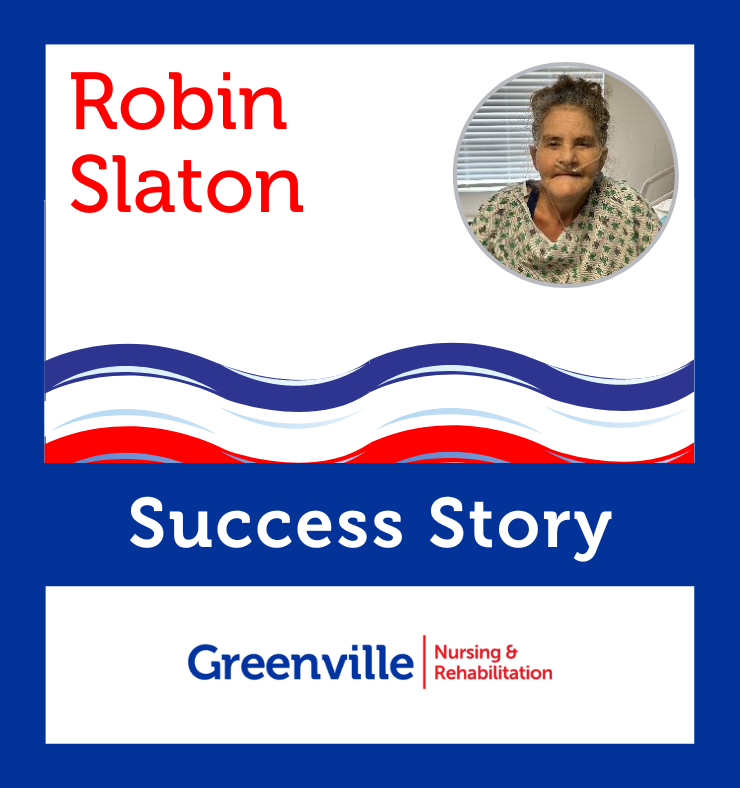
Success Story: Robin Slaton

July 6, 2023

Greenville Nursing and Rehabilitation is excited to shine the spotlight on resident Robin Slaton’s Success Story!

Ms. Robin Slaton was admitted to Greenville Nursing and Rehabilitation in March after an extensive hospital stay in critical condition. When Robin was first admitted, she could not transfer out of bed, stand, or walk and needed help with most of her activities of daily living. She could not swallow solid foods and required a puree diet. Robin’s goal was to return home with her husband, and she had family and friends cheering her on throughout her stay!

Robin is a very friendly, caring person who enjoys socializing with fellow residents and participating in facility activities. She worked with physical, occupational, and speech therapy and was motivated to participate even when she was not feeling well or emotionally having a bad day. She worked hard each day and was able to regain her ability to eat regular foods again. When the day came for her to discharge, she was walking with a walker, transferring with minimal assistance, and able to attend to her daily tasks! Because of her determination and hard work, Robin was able to meet her goal and was discharged back home with her husband in May! Congratulations to Robin and her Care Team on their success!

Caregiving for a Person with Alzheimer’s Disease or a Related Dementia

June 26, 2023

What is Alzheimer’s Disease?

Alzheimer’s disease is the most common form of a group of brain diseases called dementias. Alzheimer’s disease accounts for 60% to 80% of dementia cases. Other forms of dementia include vascular dementia, mixed dementia, dementia with Lewy bodies, and frontotemporal dementia.

Alzheimer’s disease, like all dementias, gets worse over time and there is no known cure. Nearly 6 million Americans are living with Alzheimer’s disease. Alzheimer’s disease destroys brain cells causing problems with memory, thinking, and behavior that can be severe enough to affect work, lifelong hobbies, and social life. Eventually, it can affect one’s ability to carry out routine daily activities. Today, it is the sixth leading cause of death in the United States. It is the fifth leading cause of death for those aged 65 years and older.

For more information, see www.alz.org/alzheimers-dementia/facts-figuresexternal icon.

What is known about caregiving for a person with Alzheimer’s disease or another form of dementia?

People with Alzheimer’s disease and related dementias are usually cared for by family members or friends. The majority (80%) of people with Alzheimer’s disease and related dementias are receiving care in their homes. Each year, more than 16 million Americans provide more than 17 billion hours of unpaid care for family and friends with Alzheimer’s disease and related dementias. In 2019, these caregivers will provide an estimated 18.5 billion hours of care. Approximately two-thirds of dementia caregivers are women, about one in three caregivers (34%) is age 65 or older, and approximately one-quarter of dementia caregivers are “sandwich generation” caregivers, meaning that they care not only for an aging parent, but also for children under age 18.

Caregivers of people with Alzheimer’s and related dementias provide care for a longer duration than caregivers of people with other types of conditions (79% versus 66%). Well over half (57%) of family caregivers of people with Alzheimer’s and related dementias provide care for four years or more. More than six in ten (63%) Alzheimer’s caregivers expect to continue having care responsibilities for the next 5 years compared with less than half of caregivers of people without dementia (49%).

The demands of caregiving can limit a caregiver’s ability to take care of themselves. Family caregivers of people with Alzheimer’s and related dementias are at greater risk for anxiety, depression, and poorer quality of life than caregivers of people with other conditions.

To learn more, please visit https://www.cdc.gov/aging/caregiving/alzheimer.htm.